

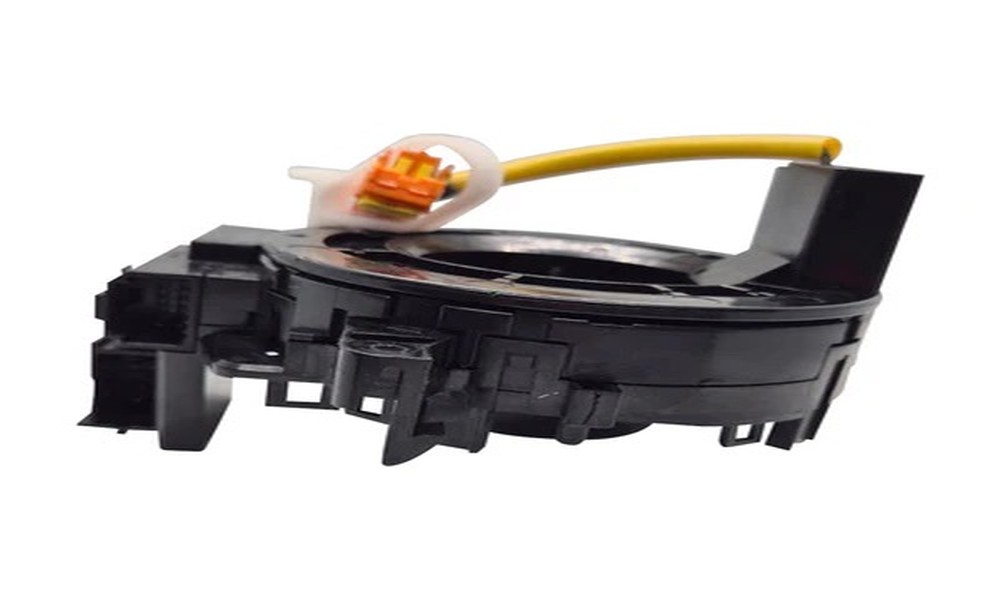
A clock spring spiral cable is the quiet part that keeps your steering wheel electrical connection alive while you turn. It’s also known as a clockspring, spiral spring, or spiral cable, depending on the manufacturer and service manual.
In simple terms, it’s built to handle rotation without breaking the circuit. Many clockspring units store energy on a rotating axis. They use a flat multicore cable wound into a tight spiral so it can wind and unwind smoothly.
This special rotary electrical conductor sits at the heart of the steering system’s wiring path. It helps the airbag clock spring keep the airbag module powered and ready. It also carries signals for the horn and steering wheel buttons.
Some designs reach the same goal with spring-loaded brushes that ride on concentric slip rings. Instead of a wound-steering-wheel spiral cable, they aim for steady contact through constant turning.
Because it’s hidden, the clock spring coil is easy to forget-until warning lights pop up or controls stop working. It may also be labeled as a coil spring unit, contact reel, coil assembly, or cable reel assembly. But the job stays the same.
Key Takeaways
- A clock spring spiral cable maintains the steering wheel electrical connection during turns.
- It’s also known as a clockspring, spiral spring, or spiral cable in automotive service language.
- Most units use a flat multicore ribbon wound in a spiral to flex without breaking circuits.
- It acts as a rotary electrical conductor for the horn, buttons, and other steering wheel controls.
- The airbag clock spring is critical for maintaining airbag wiring continuity.
- Some systems use slip rings and brush contacts instead of a spiral-wound cable.
Understanding The Clock Spring Spiral Cable In Modern Steering Systems
In today’s cars, the clock spring spiral cable connects the steering wheel to the car’s electrical system. It keeps the electrical signals steady as the wheel turns.
This design stops wires from breaking when the steering wheel moves. The cable winds and unwinds inside a housing. This lets power and data flow during driving.
Many controls, like the horn and cruise control, rely on this cable. They all share the same path, even though they do different things.
Some cars send extra signals through this unit. They use multiple connectors and conductors. This includes a traction control interface and other switch inputs.
If the conductors crack or wear out, problems can occur. A driver might lose the horn and controls at once. Or see an airbag warning light and cruise control issues at the same time.
| Steering wheel feature | How the clock spring supports it | What may be noticed if continuity is lost |
| Airbag electrical connection | Maintains a stable signal path through the rotating column | Airbag warning light, stored fault codes, disabled airbag system |
| Horn circuit | Completes the circuit when the horn pad is pressed | Horn does not sound or works only at certain wheel angles |
| Cruise control buttons | Sends switch signals without wire twist during turns | Buttons do nothing, cruise cancels, or intermittent response |
| Radio steering wheel buttons | Carries low-voltage control signals with minimal interference | Volume/track controls fail or lag, while steering |
| Traction control interface | Routes commands from wheel-mounted switches to vehicle modules | Switch input not recognized, feature won’t toggle, warning messages |
Where The Clock Spring Is Located And What It Looks Like
The clock spring is hidden from view. It’s found between the steering wheel and the column. This spot is where the wheel meets the upper shaft and switch gear.
When you take off the steering wheel, the clock spring is easy to spot. It looks like a flat, round unit, often black or yellow. You’ll see wiring going into the column.
The outer part is a spiral cable housing. It’s built to fit snugly with the wheel and column. Inside, the conductor is wound in a spiral. This lets it move as the wheel turns.
On the column side, it looks like a drum. In many cars, yellow wires are a clear sign. They lead from the unit into the column, near the airbag and steering controls.
| What you notice | What it usually means | Where you’ll see it |
| Flat, round cartridge (often black or yellow) | Main clock spring body designed to stay centered | Between steering wheel and steering column after wheel removal |
| Spiral cable housing with locking tabs and plug ports | Protects the spiral-wound conductor and keeps connectors secure | Inline with the column cover and switch assemblies |
| Steering column drum shape at the column’s front end | Clock spring positioned to feed circuits down the column | Front end of the steering column assembly near the stalks |
| Yellow wires clock spring routing into the column | Airbag and horn/steering-wheel control circuits entering the harness | Running from the unit into the steering column channel |
Clock Spring Anatomy: Internal Parts And Design
The clock spring parts are in a round housing behind the steering wheel. They keep circuits live as the wheel turns. Most use a flat multicore cable in a tight coil, protected from damage.
This coil structure gives the part its clock-like shape and controlled movement. Inside, the cable acts as a spiral-wound conductor. It winds and unwinds as you steer.
In many vehicles, the contact reel design lets the cable retract and expand smoothly. This prevents the conductors from twisting or getting worn out too fast. The goal is steady power and clean signals through full left and right lock.
Multiple connectors route those circuits to the systems mounted on the wheel. Depending on the model, connectors may feed the airbag circuit, the horn switch, and steering wheel controls. Fit and alignment matter, because a loose connector can create heat, noise in signals, or an intermittent warning light.
Some designs use a slip ring brush to pass current across a rotating joint. It’s a different approach, but it targets the same need: reliable contact under vibration and frequent steering input.
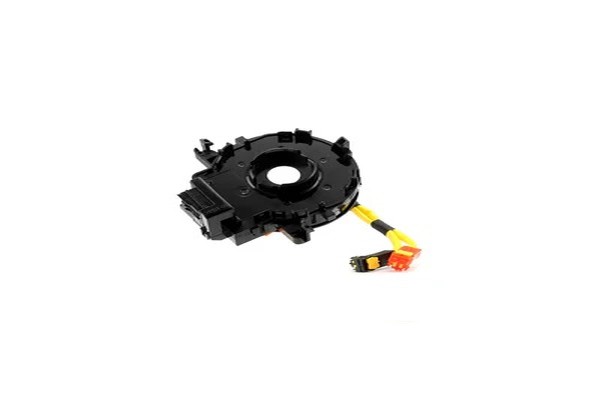
Heat can also shape what fails first. After airbag deployment, the rapid gas reaction and heat exchange inside the cylinder can leave connectors melted and fused to the surrounding plastic, making replacement necessary. That risk is one reason technicians treat the housing and plugs with extra care during inspection.
| Design element | What it does in operation | Typical stress point | What techs look for during checks |
| Flat multicore cable | Carries several circuits in a thin ribbon while allowing controlled bending | Creasing from over-rotation or improper centering | Kinks, uneven winding, or signs of rubbing in the housing |
| Spiral-wound conductor path | Maintains continuity as the coil winds and unwinds with steering angle | Conductor fatigue over many turn cycles | Intermittent faults, cracking sounds, or warning lights tied to wheel movement |
| Contact reel design | Guides the coil so it retracts and expands without binding | Misalignment after steering or column work | Off-center reel position and uneven return-to-center feel |
| Connectors | Link the rotating wheel circuits to the fixed vehicle harness | Loose fit, bent pins, or heat damage | Pin condition, locking tabs, and any melted or fused plastic near the airbag plug |
| Slip ring brush design | Transfers power using brushes sliding on concentric rings instead of a cable | Brush wear or contamination on ring surfaces | Dust buildup, uneven wear marks, and inconsistent contact pressure |
How A Clock Spring Works While The Steering Wheel Turns
Imagine a flat ribbon cable coiled in a round housing behind the wheel. When you turn the wheel, the coil moves. This keeps the electrical connections smooth, even when the wheel moves a lot.
The ribbon cable moves in a loop, guided by the housing. This motion is key for steering wheel wiring. It connects the wheel to the car’s electronics, like the airbag and horn.
It also sends signals from the steering wheel buttons. These signals go to the car’s body electronics. When everything works right, these signals stay clear with every turn.
| What’s happening | What you may notice in the car | What it usually means |
| The ribbon winds and unwinds to maintain electrical continuity during steering | Airbag light stays off and steering wheel controls respond fast | Normal operation of the clock spring connector path |
| The internal cable retracts and expands but begins to drag in the housing | Clicking rubbing sound steering during turns, sometimes louder at low speed | Wear, mis-centering, or debris in the clock spring assembly |
| One or more conductors crack from repeated steering wheel rotation wiring cycles | Horn cuts out, buttons stop working, or warning lights appear | Loss of continuity; the clock spring can no longer carry current reliably |
| Intermittent contact creates brief voltage noise in the circuit | Rare drivability oddities and less smooth steering feel in some cases | Electrical spikes that may disturb the throttle position sensor, which helps maintain airflow to the intake manifold by tracking the throttle valve |
When a clock spring starts to fail, a broken conductor is often the cause. This can lead to random dropouts. If you hear a clicking rubbing sound while turning, it might be a sign of trouble.
Why Clock Springs Matter For Safety And Drivability In Australia
In Australia, the clock spring is often ignored because it’s hidden behind the steering wheel. But it’s vital for keeping electrical connections as the wheel turns. If it weakens, many steering wheel systems can fail at once.
The biggest worry is about airbag reliability. The clock spring sends signals between the airbag module and the car’s control unit. If this circuit breaks, the airbag might not work in an emergency, making the car less safe.
It also keeps the horn and steering wheel controls working. If the horn stops working, it’s harder to warn others on the road. This is important on long drives and in busy cities.
Drivers might notice problems before the clock spring fails completely. They might hear clicking or feel rubbing when turning. These signs should not be ignored. After an airbag goes off, the heat can damage the system, making it unreliable until fixed.